Markdown Strategy: Turning Excess Inventory into a Smarter Retail Decision

Not every product sells as planned.
Demand may be lower than forecast. A trend may move on. Weather may change. Or the retailer may simply have bought too much.
Eventually, one question appears:
Should we wait, reduce the price, or clear the inventory?
That's where markdown strategy comes in.
And an important point: a markdown isn't necessarily a failure. A bad markdown strategy is.
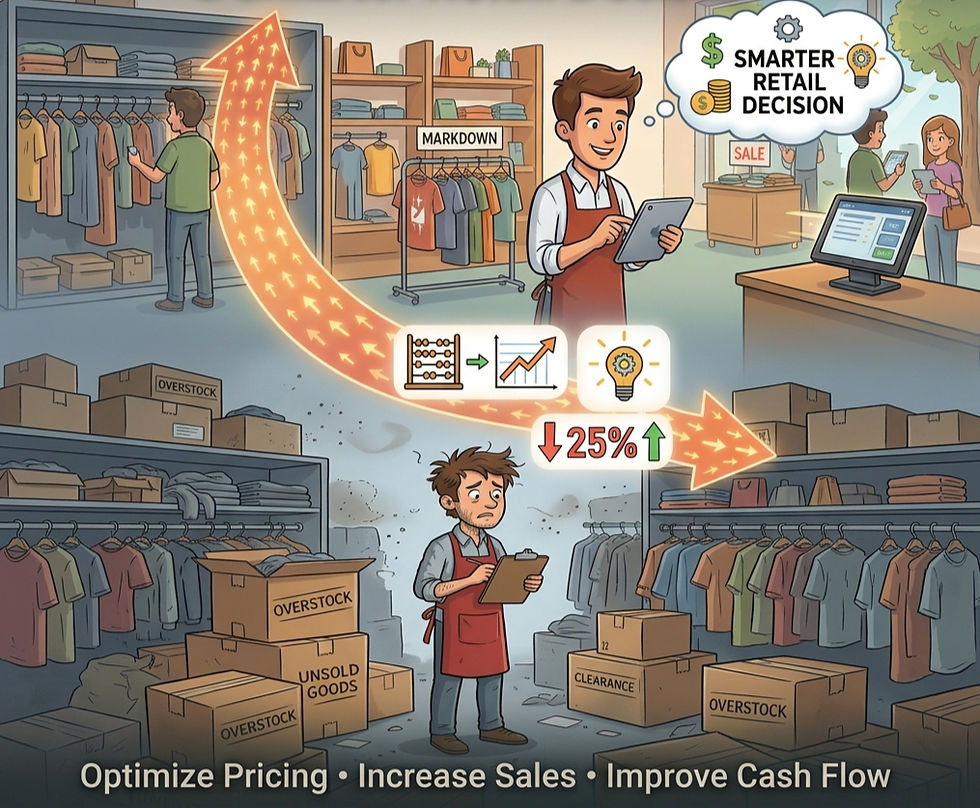
What Is a Markdown?
A markdown is a planned reduction in the selling price of a product to increase sell-through and reduce excess inventory.
For example:
Original price: €100First markdown: €80 → 20% reduction
Second markdown: €60 → 40% reduction
The objective isn't simply to sell the product.
It's to balance:
Sell-through + Margin + Inventory
Timing Can Be More Important Than the Discount
Imagine a retailer has 1,000 jackets priced at €100.
After several weeks, only 500 have sold, leaving 500 units.
The retailer introduces a 20% markdown and sells another 300 units at €80.
300 × €80 = €24,000 revenue
If the retailer waits too long and eventually needs a 50% markdown:
300 × €50 = €15,000
That's a €9,000 difference on the same 300 units.
The lesson:
A smaller markdown at the right time can be better than a deeper markdown too late.
The Four Questions Behind Markdown
A good markdown strategy should answer four questions:
WHAT? Which products actually need a markdown? Consider sell-through, inventory and future demand.
WHERE?A product may be slow in one store but selling strongly in another. Why markdown both?
WHEN?Should we act now or wait? Remaining selling time matters.
HOW MUCH? Is 20% enough, or does the product require 40%?
This is why leading retailers increasingly use SKU-level, store-level and channel-level data rather than applying the same discount everywhere.
Don't Discount Everything
One of the simplest—and often least effective—approaches is:
"Everything is now 30% off."
A strong-selling product may still sell at full price.
Another may need 20%.
A third may need 40%.
The right markdown depends on demand, inventory, price sensitivity and the remaining selling window.
Modern retailers increasingly combine analytics with merchant judgement to make these decisions.
Markdown Starts Before the Markdown
Markdown is actually connected to every stage of merchandise planning:
MFP → How much can we invest?
Demand Forecasting → How much might customers buy?
Assortment Planning → What should we offer?
OTB → How much should we purchase?
Allocation & Replenishment → Where should inventory go?
Markdown → What do we do when actual demand doesn't match the plan?
The better the decisions upstream, the less pressure there should be downstream.
Final Thoughts
The goal of markdown isn't to discount everything.
It's to make the right price decision, at the right time, for the right product, in the right location.
You can't always avoid markdowns.
But you can avoid unmanaged markdowns.
At MerchFlow Consulting, we believe merchandise planning doesn't end when a product reaches the store. It continues throughout the product lifecycle—from financial planning and forecasting to buying, allocation, selling and, when necessary, markdown.
One final question to close our Retail Planning Series:
How does your organisation decide when to markdown?
Fixed calendar? Sell-through triggers? Analytics? Or merchant judgement?
We'd love to hear what works for you.


Comments